
Considering Lilies
Multiplying Life, Acre by Acre

Long ago, the most extraordinary man rode upon this magnificent twirling earth. He came here on the most extraordinary mission—to save the world. This man was pure, just, moral, and upright in all ways. His was a life of profound sacrificial love. They called him Christ Jesus of Nazareth. This exceptional individual realized that most of the people he encountered were not living rightly, justly, or joyfully. And so He spent his time devoted to teaching and living the mysteries and wonders of our loving Creator. He walked among humanity in service to their spiritual maturity—helping them strengthen their relationships to the ONE who sent him.
This Nazarene showed humanity how to make the kingdom of heaven a literal reality in their daily lives. He healed the people of their physical, moral, and spiritual ills. People called him a miracle worker, such was his ability to make good take root where evil had once been rooted. Astonishingly, he even lifted people out of the dark illusion of death and showed them the miraculous way to life everlasting. Indeed, history has not recorded a greater authority on our earthly and eternal lives. Nor has history recorded a wiser teacher, gentler gentleman, more discerning counselor, kinder neighbor, braver truth-teller, more effective healer, nor one who loved so deeply, unselfishly, and sacrificially. Nor one whose life and works have been more misunderstood and misrepresented.
A World for Restoration and Rejuvenation
To find reprieve from the hustle and discordance of the human-made world, Jesus of Nazareth would retreat into the God-made Creation for restoration and rejuvenation, where he must have spent substantial time considering the natural wonders, big and small, of the great I Am. Surely this is where he obtained much of his unfathomable wisdom.
One of Jesus’s most remarkable practices was to take a profound facet of God’s righteous ways and conceal it in a brief vignette, or piece of advice called a parable. The hearers could mull over and unpack the deeper meaning, if they desired. It seems Jesus wanted the people to unearth the meanings on their own and to inspire people to be more God-trusting, childlike, and peace-filled. Millennia later, his parables still confound many, and continue leading ponderous listeners into a newness of life.
One day, his fellow humans were consumed with themselves, as humans often are. They were worried about what they would eat, drink, and wear. This Nazarene advised his companions to stop worrying about such things. He outrageously suggested that they should alternatively consider the lilies of the field. As if lilies have anything to do with paying the bills and meeting our needs! What a whacky thing to say. Had Jesus lost his marbles? Jesus went on to tell them that lilies do not toil or spin, yet they still grow. He furthermore claimed that lilies were truly better arrayed than even Solomon, the historical Jewish ruler known for his wisdom and astounding opulence.
Jesus’s friends interpreted his absurd advice as if he’d instead declared: “Consider Solomon,” which is what they did. The Solomons of the world—the presidents, kings, prime ministers, and premiers—do tend to shriek much louder than the lowly voice of a small, silly lily.
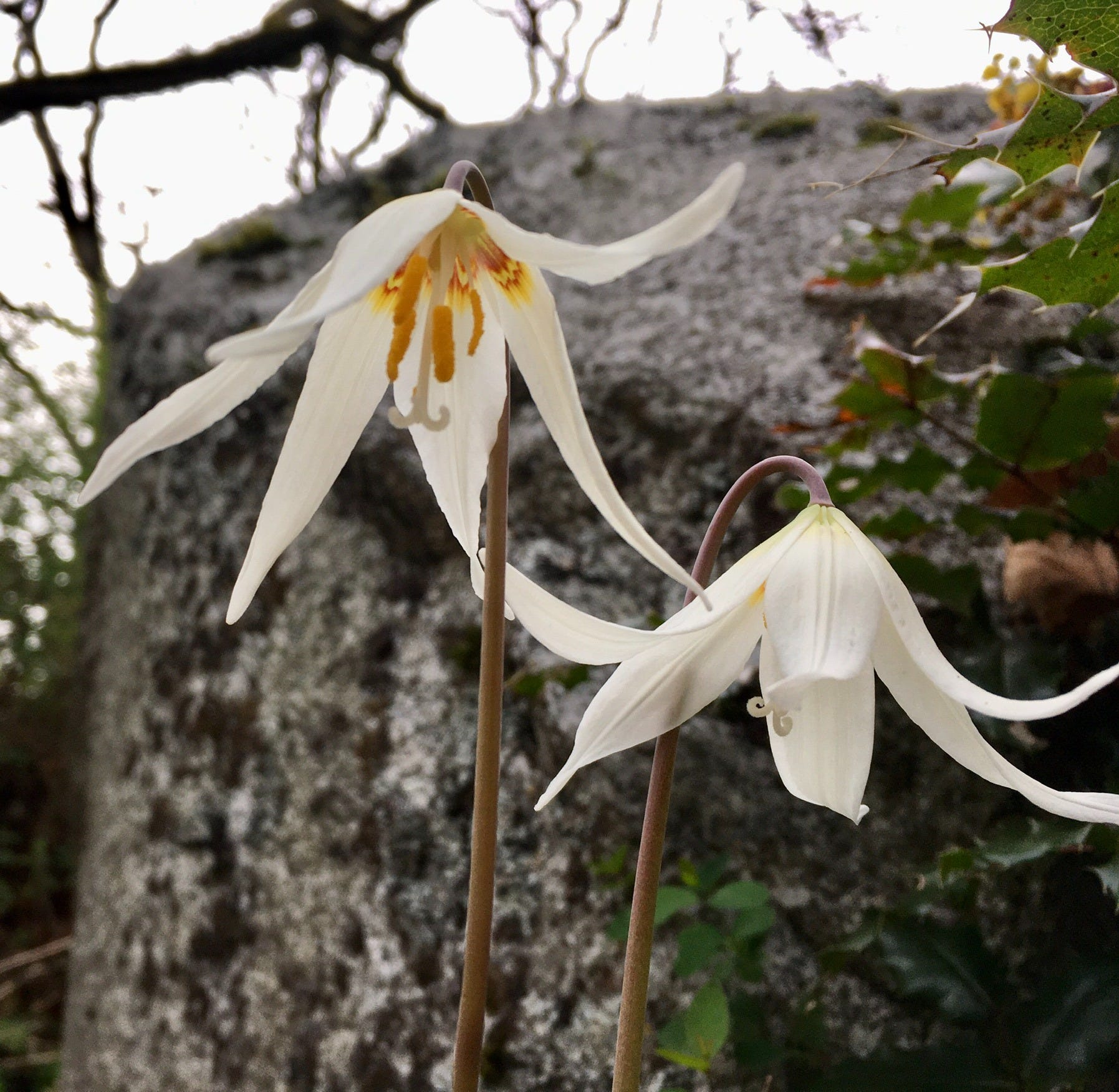
By “consider,” Jesus meant to go out and ponder, attentively observe, study, notice, and meditate on…lilies! Considering lilies requires a unique kind of attentiveness. A quieting of the mind to hear a still small voice. To properly consider a lily requires humility, effort, sincerity, imagination, patience, and open-mindedness.
We have little indication that anyone ever followed Christ’s advice about the lilies.
Reflecting a Vaster Intelligence
If we were to consider the lilies, we might come to see that lilies do not exist through any power of their own. Indeed, they reflect a vaster intelligence. Since they come directly from the Imagination of God, they reflect his infinite mind. This is what gives them their life, symmetry, elegance, and floral aroma while simultaneously caring for them. Lilies are the Divine Qualities of cooperation, gladness, elegance, and serenity, fragrantly expressing itself.
Each lily reflects the Creator’s glory with petals that unfurl in their own special way, releasing aromatic pollen in their own due time. Lilies live in harmony with the community of life alongside joyful daisies, humble clover, and roaming animals and people alike. Unlike people, lilies maintain purity in their lives and remain free of the human ailments of greed, bitterness, suspicion, anxiety, and fear. With lilies, there is never domination, dreariness, or disputes.
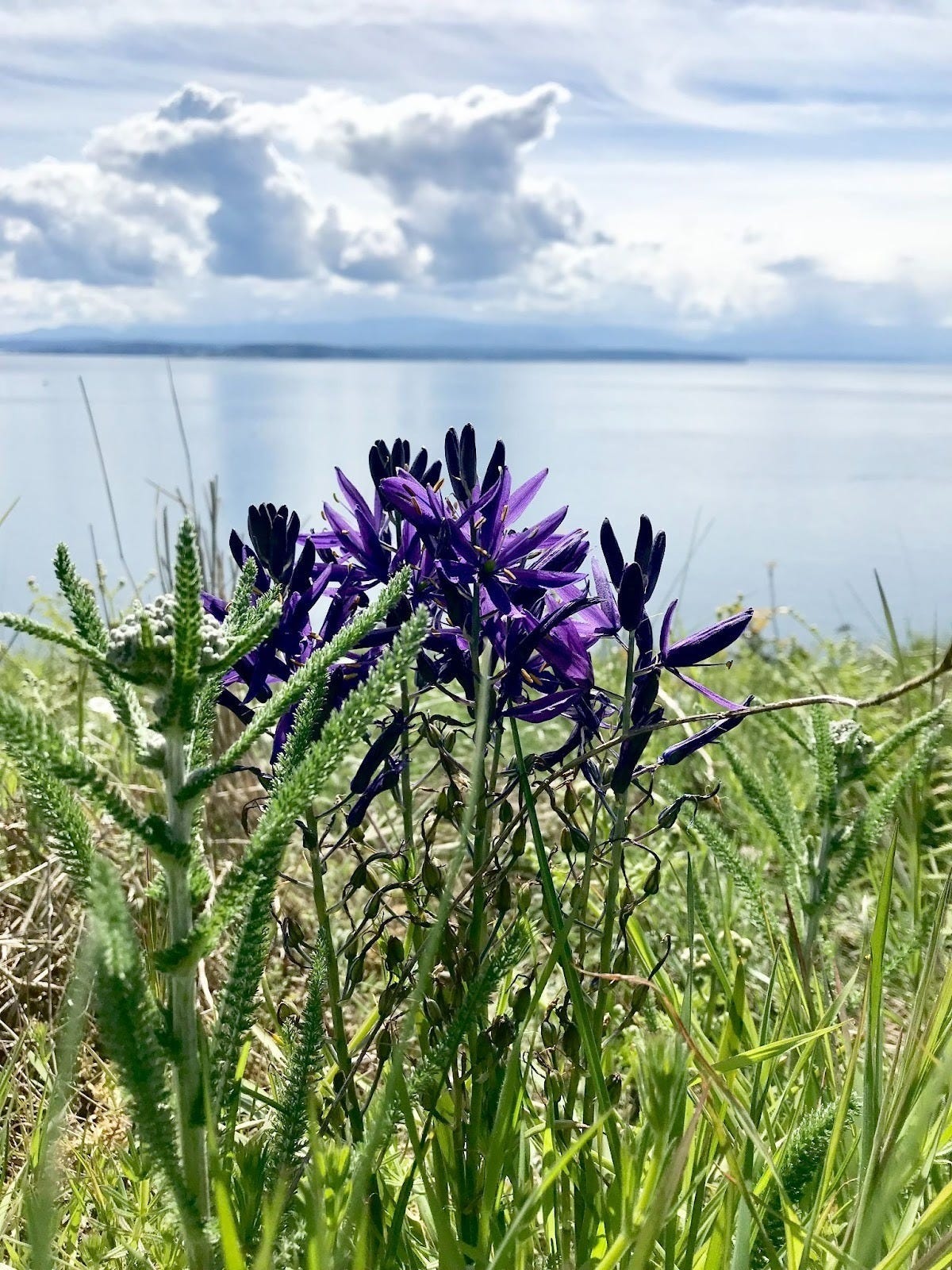
Throughout the Pacific Northwest, an edible lily once lived here bountifully: the camas lily—a staple food for the Salish tribes of the Pacific Northwest. Externally, this noble lily is graceful, generous, and arrayed in a dappled rich indigo more wondrous than anything human, including Solomon in all his glory. Upon ingestion, camas bulbs are tender, sweet, delicious, satisfying, and nutritive.
From Abundance to Near Elimination
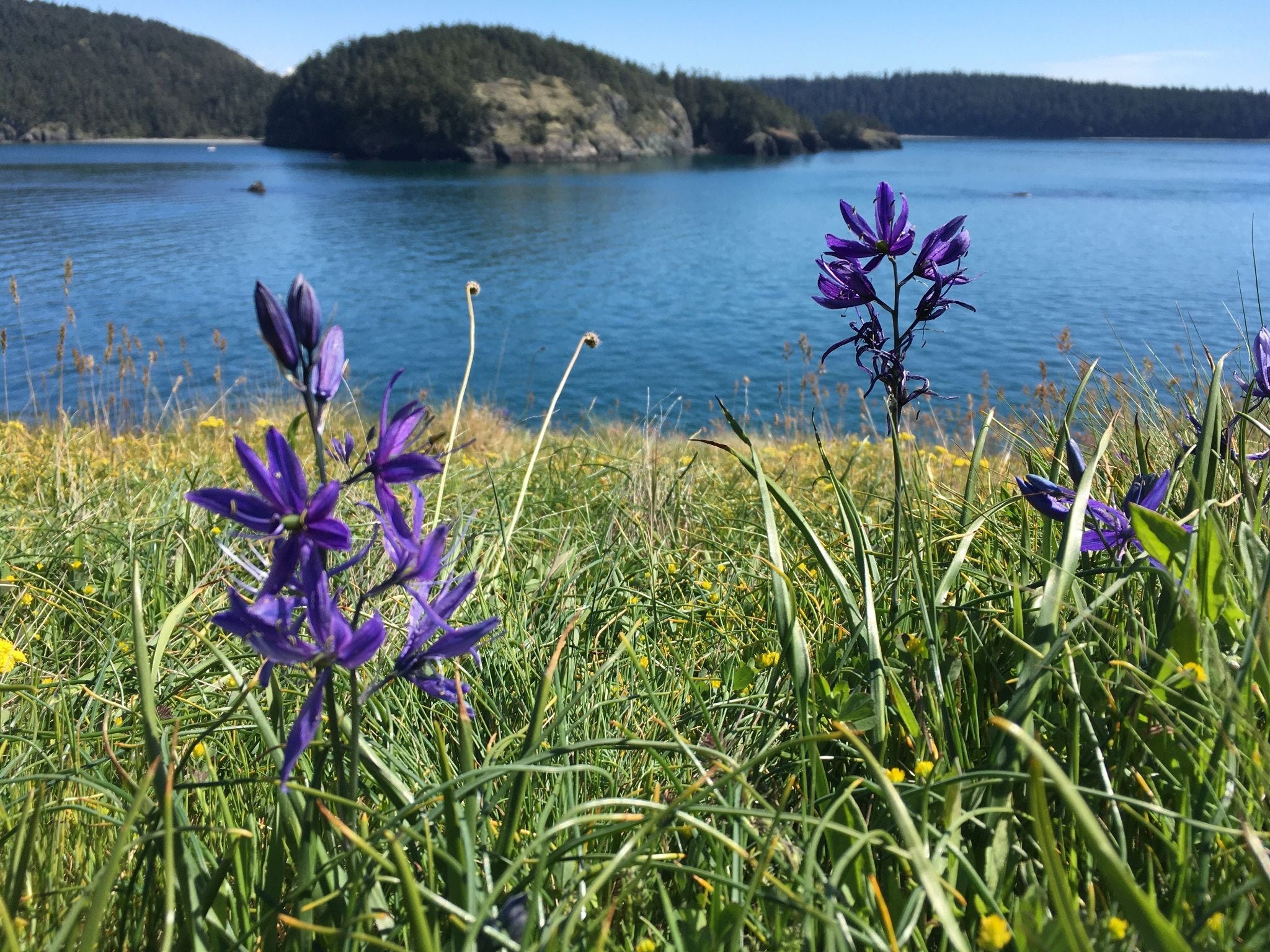
Camas historically grew plentifully and beauteously in the meadows, prairies, and savannas of the Pacific Northwest. In springtime, this floral food carpeted the earth’s floor in a dreamy blue haze.
Meriwether Lewis described camas in this way, in 1806:
“The quawmash is now in bloom and from the color of its bloom at a short distance it resembles lakes of fine clear water. So complete in this deception that on first sight I could have sworn it was water.”
In Salish culture, the camas beds were stewarded by individual families who cleared the stones and brush—often through controlled burning during the summer. Each year, the families would come to their special spots, set up temporary shelter, and spend weeks harvesting the tasty food that would get them through the long rainy winters. Only the larger bulbs were taken and the small ones were left behind to ensure abundance for their future unborn children—whom these Native peoples loved very much. They would steam the hearty bulbs in large pits for up to three days. The food could be served straight away at potlatches and gatherings, or dried for trading or winter stores. The cooked bulbs are rich in the complex sugar inulin and, when paired with another dish, act as a natural sweetener. They’re the only source of carbohydrates in the traditional Salish diet. Their flavor is similar to a baked pear.
Nowadays, wild camas lilies are almost entirely eliminated from this region because they grow in the most prime real estate—the flatlands. At least ninety-nine percent of the Pacific Northwest prairies are degraded beyond recognition due to being paved over, clear-cut, or replanted with non-native plants for pasture and ornamental landscapes. The scant remaining prairies continue to be threatened by habitat loss from development and pollution. Coating plants with car exhaust interferes with photosynthesis.
I heard a Salish elder once say that the I-5 freeway south of Seattle used to be acres and acres of camas prairies. He said when the wind blew, the cerulean prairies resembled sparkling ocean waves—as if beckoning all to come and feast on the sweetness hidden under the earth. Today, this land hosts a noisy, polluting freeway flanked by hundreds of miles of inert black asphalt, parking lots, strip malls, a bustling airport, business parks, and big-box chain stores.
Though the camas prairies are basically obliterated, some towns still bear the names of what the land once was: “Brush Prairie,” “Camas,” and “Yelm” (a Nisqually word meaning heat mirage seen over a prairie). Given the vast desecration of this ecosystem, most people in the Pacific Northwest are completely ignorant of this lily—having never even heard of camas—even though camas was THE MOST essential culinary plant native to this region. It’s difficult to consider the lilies if there are no lilies to consider.
Extinguishing the Heart of the Land
Because the past did not consider the future, camas and many other medicinal and culinary plants are critically endangered, such as wild echinacea, goldenseal, American ginseng, trillium, peyote, gentian, elephant tree, and the American chestnut tree. Some beings of the past were so entirely unconsidered that they have been fully exterminated, like the passenger pigeon, the great auk, the Tacoma pocket gopher, the St Helena olive tree, and silphium—an ancient plant that was picked into extinction by the Romans. Used as both an aphrodisiac and a contraceptive, silphium was so valuable that its image was etched into Cyrenian coins. It is thought that the heart symbol for love comes from the heart-shaped leaves of this extinct plant.
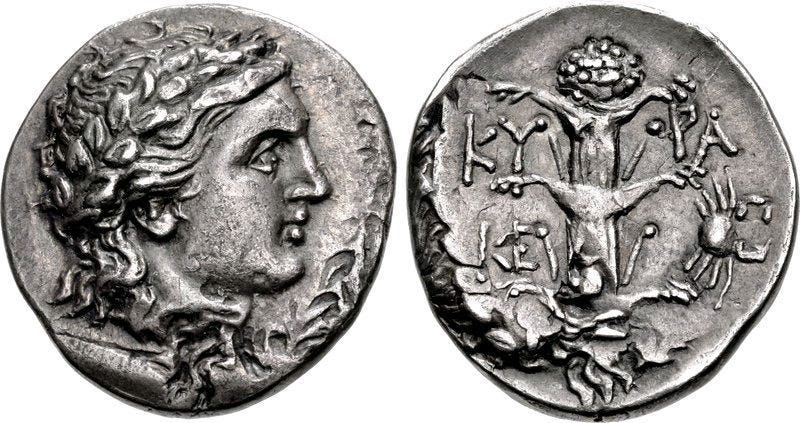

So many precious life forms are gone. While many may struggle to name all that has been lost, the sensitive ones feel these losses. There is a heaviness and grief for a world they never knew—a sacred, wonder-filled paradise that should have been ours by birthright. Instead, we received a desecrated world where living wonders were liquidated for profit long ago. There is a word for this feeling: solastalgia—a homesickness despite being home, caused by perceived environmental change.
“The good of the whole of Creation, the world and all its creatures together, is never a consideration because it is never thought of; our culture now simply lacks the means for thinking of it.” —Wendell Berry
I grew up surrounded by stories of the river that fed me and grew me up. When I was a child, the elders would recount stories they had heard in childhood from their elders about how the river had once been so replete with salmon that one could just sashay across the river on the fish’s backs. “You wouldn’t even get your feet wet!” they said. My great uncle told me that during the Great Depression, they didn’t even know there was a depression, so full of salmon were their bellies. In those days, the salmon were huge, 70 to 120 pounds! Today, the average King salmon is about 20-30 pounds, whereas Silver salmon is 6-12 pounds. The river has been so dammed up that the salmon runs are a paltry 5% of what they once were.
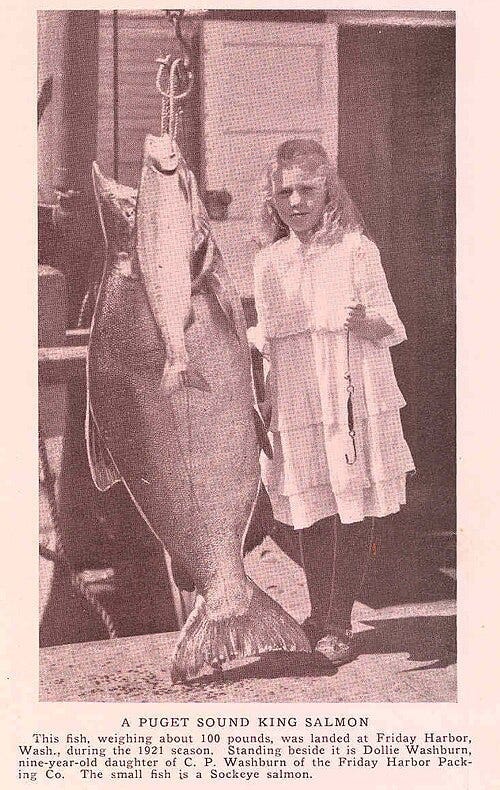
The Waning Applause for the Creator
When early European explorers came to Turtle Island (North America), they remarked on the abundance of life. One early explorer wrote in his journal that he couldn’t sleep at night, so clamorous was the sound of the many many fish clapping against the waters. He described this racket as one of the most unusual sounds he had ever heard, similar to applause. Today, nobody remembers when the rivers thrummed with the claps and flops of trout in ceaseless praise. The beats of those ballads dissipated so very long ago.
In their journals, Lewis and Clark described condors soaring all around the Pacific Northwest. Condors are the largest birds in North America with a wing span of nine feet! They have been described as astute, playful, and social. I’d never even heard of a condor in my life until a few years ago. I’ve certainly never seen one! That they once soared over my birthplace is news to me. When the condor was on the brink of total extinction, some conservationists finally considered these birds. Because of their consideration, the condor remains, and we can still behold this bird of the air—these mighty Thoughts of God expressing majestic condors.
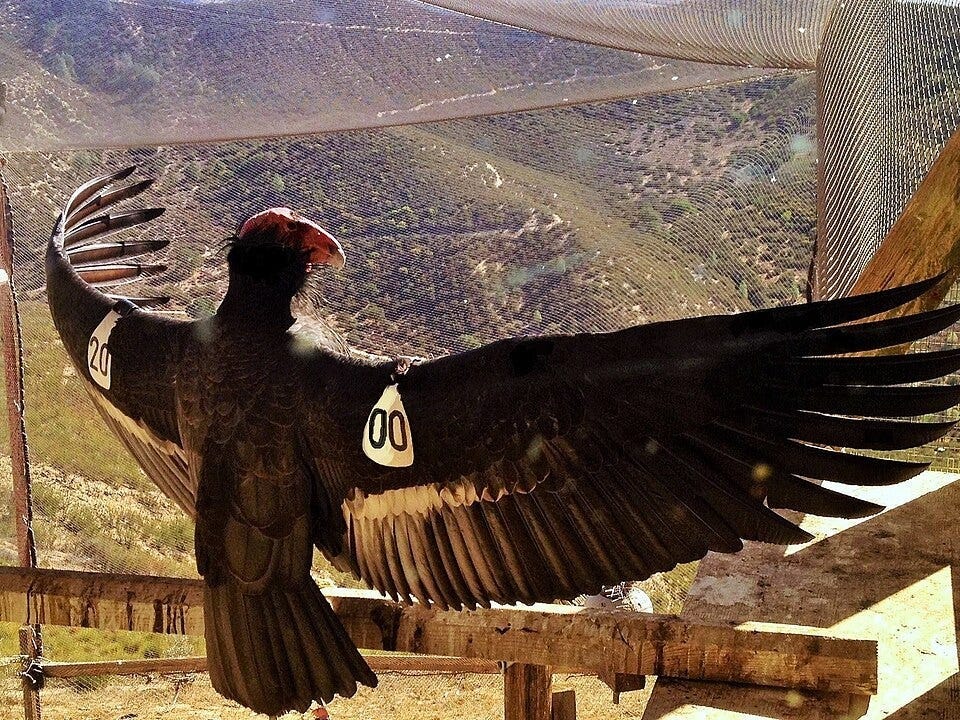
Replenishing Eden
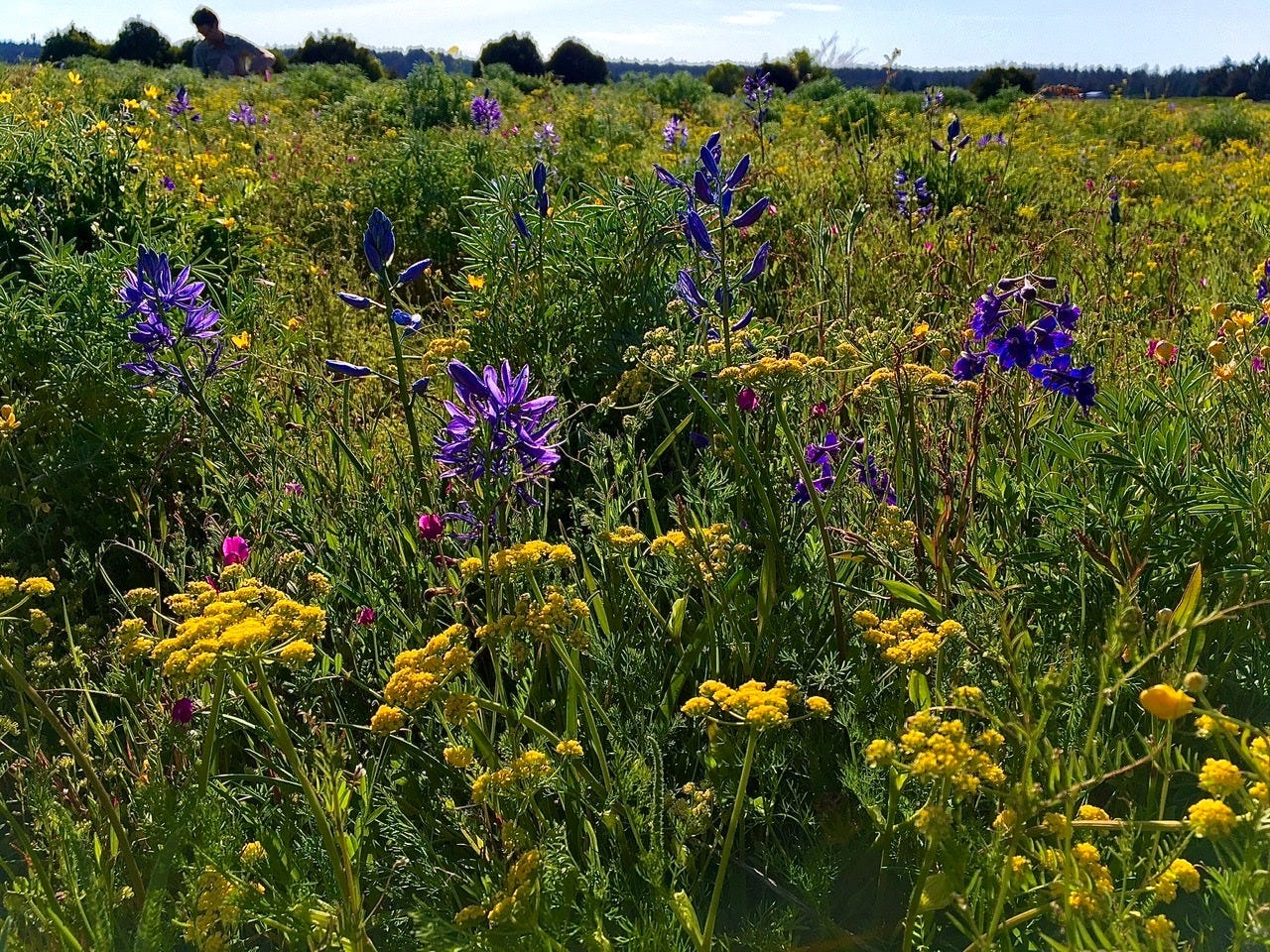
In 1997, a piece of land was up for sale for development. Some folks were out walking this land when their attention was arrested by extremely rare flowers. I guess you could say they were considering the lilies. What they discovered were four acres of unspoiled ancient prairie. Unbelievably, it had never been cleared, paved over, or turned into pasture and munched on by non-native animals. Ever. There, somehow quietly persisting was a little crumb of the past. A sliver of Eden. On this land, they found not just camas but other culinary plants in the lily family: nodding onion (which helps digest camas), tiger lily (whose bulbs are roasted and taste like chestnuts), and chocolate lily (its bulb is said to taste somewhat like bitter sticky rice). They found potent medicinal plants like yarrow, also known as the great wound healer; biscuitroot, an antiviral plant; goldenrod, an effective remedy for UTIs; sea thrift, thought to be an antibiotic; and graceful golden paintbrush, which serves as a womb for the breathtaking but critically endangered Taylor’s Checkerspot Butterfly.
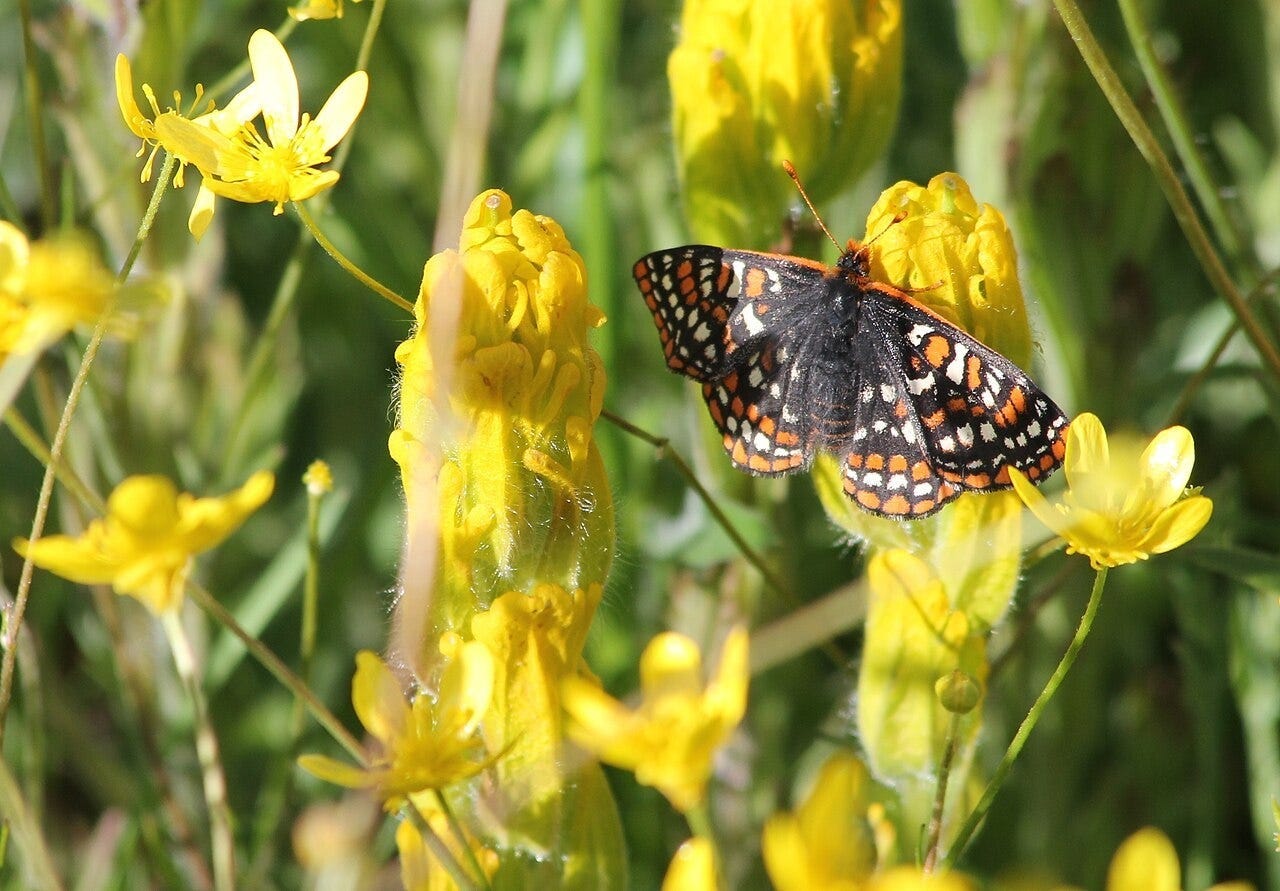
.jpg)
Not only had they stumbled upon a rare therapeutic landscape full of food and medicine, but also acres arrayed in bursts of colors and intricate designs, with buzzes and flaps of pretty pollinators feasting. The lily considerers evolved into lily stewards, and purchased that speck of Eden to conserve for the unborn future. From there, they evolved into stewards of golden paintbrush—a plant teetering at the time on the brink of extinction, yet eventually removed from the list of critically endangered plants through the work of those committed to the fruitful multiplicity of life. Because there are now more golden paintbrush plants, there are more places for the Taylor’s Checkerspot butterfly to place their larvae so that they too can be fruitful and multiply, filling the earth with swarthy fluttering splurges and splashes of amber and auburn. What began as four acres increased to ten acres, then twenty, and then forty. Forty acres of wild food, beauty, wonder, and medicine in an unparalleled Pacific Northwest savanna. Forty acres of hope.
In considering lilies, the lily stewards considered the future. The fruits of this consideration led to a commitment to preserve God’s Wonders. For you. For me. For the butterflies. For our children’s children.
Human stewards have been loving the earth back to life, acre by acre, year by year. As long as people care, there is hope. Hope shows us what is possible. Healing isn’t just a possibility; it’s a realistic option. We need not leave the earth as we found it; through consideration and stewardship, we can leave the earth better than we found it. This is a fact. Not every endangered being gets eliminated and goes extinct. We can rejoice because we, too, can participate in the earth’s redemption.
Engaging in what Jesus practiced, such as considering lilies, cultivates avenues for us to become Christ-like. When we take Jesus’s profound counsel to consider lilies, we will come to understand that the Kingdom of Heaven really is at hand.
To consider lilies, simply sit near one and offer up the prayer: “God, what would you have to say to me inspired by this lily?” Considering lilies must be done in contemplation and intentional stillness. Observe and touch the lily; notice its color, shape, size, texture, temperature, patterns, and habitat. What other plants accompany the lily? Count the petals, stamens, and sepals. Try to put into words everything that comes to you. What does the lily remind you of? Become aware of any sensations you feel in your body. Do you feel warmth, peace, shivers? (Note, anything of fear does not come from God). Do your emotions shift? How does the rhythm of your heartbeat alter? Spend at least five minutes in stillness, open-heartedness, and intentional observation. What does your open-heart, stillness, and observation reveal to you as you consider the lilies?
We can use this prayer practice for all of God’s wonders, not only for plants but also for animals, mountains, valleys, waterways, and passing moments. You could even go to your refrigerator and consider cabbage, or your spice cabinet to consider cumin. We are not praying to animals, mountains, or cabbage, but rather asking God to reveal His wonders through His awe-filling handiwork. Practicing this level of consideration will inevitably lead to peace, joy, and righteousness (Romans 14:17). I promise you that over time, through considering Creation, your perspective will shift in the direction of irrational peace—the peculiar kind—the kind that surpasseth understanding.
O God, amidst the busy hustle and madness of today’s world, still our hearts so we may deeply consider the lilies and all that You have created. May we steep ourselves in the God-made Creation and stand in breathtaking awe. May we be compelled to live joyfully, rightly, and considerately alongside the whole Community of Life, not out of duty, but because we so love the world, and our children. Let it be so. Amen.
If you feel it is worthy, please share or re-stack this essay in service to healing our suffering earth through fostering a sense of wonder in people.
You always amaze me, dear cousin. My gratitude for you and your soul are boundless. This was profound and I loved this line especially: "It’s difficult to consider the lilies if there are no lilies to consider." Thank you for your voice. <3
Beautiful